

Hi {{first name | there}},
We all know that inflammation is bad for your health.
But a sore throat, a swollen ankle, rheumatoid arthritis, visceral fat, and plaque in an artery can all involve inflammation.
They are not the same kind of inflammation.
“Inflammation” is too often treated like a single process in the body. Someone gets a red CRP result and asks, “How inflamed am I?” An advanced panel adds seven more markers, which somehow makes the answer feel less clear.
The better question should be: What kind of inflammatory process are we looking for, and how do we measure it?

TL;DR
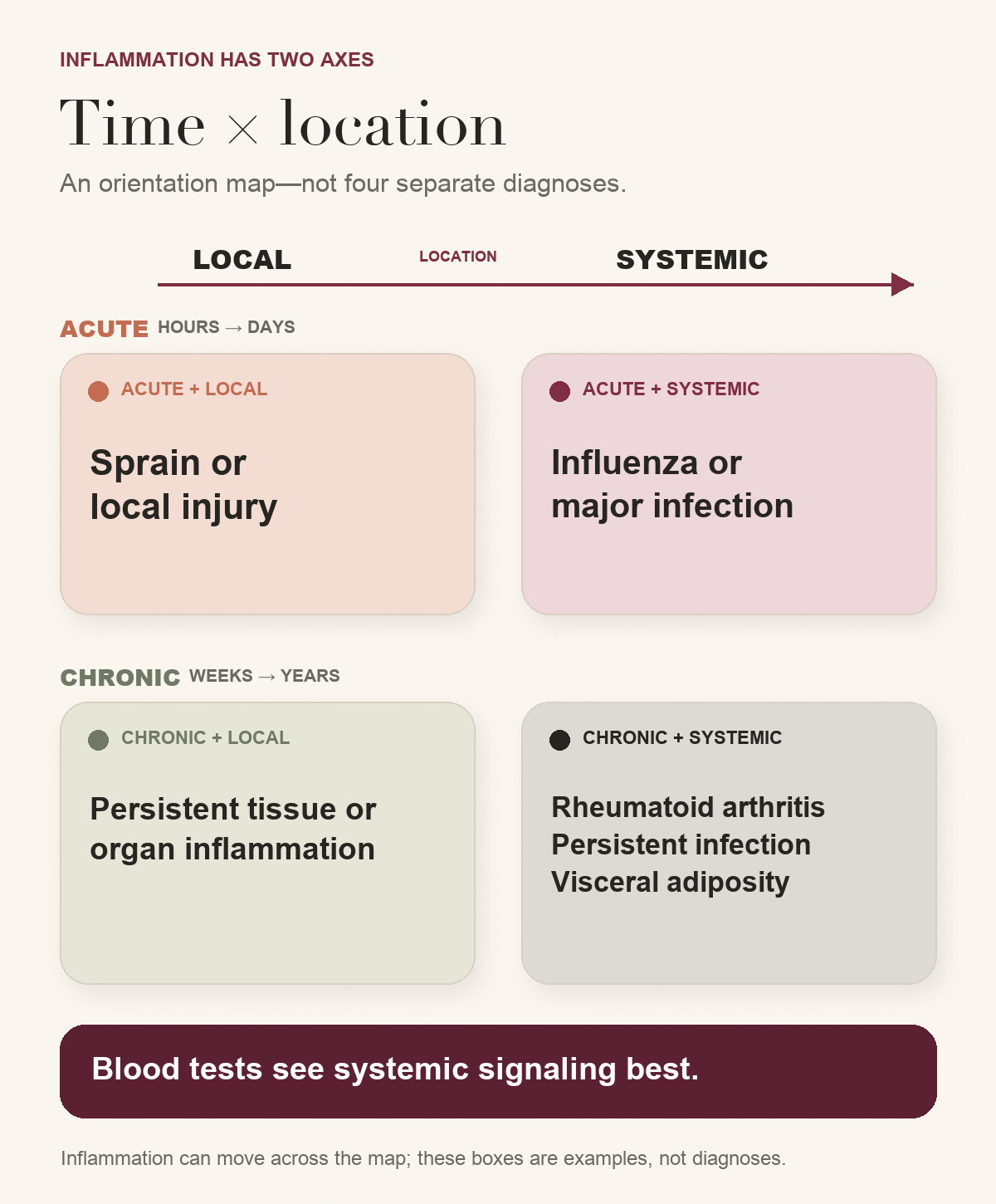
Inflammation has two separate axes: time and location. Acute versus chronic tells you how long it has been active. Local versus systemic tells you whether it is concentrated in one tissue or producing a broader body-wide response.
There is no master inflammation score. CRP, ESR, ferritin, and hsCRP measure different downstream effects and answer different clinical questions.
A high result is a clue, not a diagnosis. Timing, symptoms, related labs, and what you would do next matter more than how many markers are red.
Inflammation has two axes
Acute inflammation is the rapid response to infection, injury, or tissue damage. It is often useful: immune cells arrive, damaged tissue is cleared, and repair begins. It can last hours to days.
Chronic inflammation persists for months or years because the trigger continues, the immune system is dysregulated, or the tissue keeps being injured. Autoimmune disease, chronic infection, smoking, excess visceral fat, periodontal disease, and atherosclerosis can all involve chronic inflammatory biology, but through very different pathways.
Local inflammation is concentrated in a tissue. A sprained ankle, inflamed gum, irritated bowel, or plaque inside an artery can be biologically active while common blood markers remain normal.
Systemic inflammation produces enough circulating signaling to affect the whole body and often the liver. Fever, malaise, and a rise in acute-phase proteins such as CRP are common clues, but not every systemic process produces all three.
These categories can overlap. A sprained ankle is usually acute and local. Influenza can create an acute systemic response. Rheumatoid arthritis is chronic and systemic. An individual atherosclerotic plaque is chronic and local. The disease can affect arteries throughout the body, and some people also have a higher systemic signal.
Those labels describe time and location, not cause. The trigger may be an infection, an autoimmune or allergic response, tissue injury, or ongoing metabolic or toxic stress such as visceral adiposity, smoking, urate crystals, or plaque. The same CRP rise can come from very different pathways.
Start with the question you're trying to answer
Is there a systemic inflammatory response right now? (Are you sick?) Start with CRP.
Is this a slower rheumatology or chronic-inflammatory question? ESR may help.
Is this an iron question? Use ferritin with transferrin saturation.
Are you refining cardiovascular risk in someone who feels well? Use hsCRP.
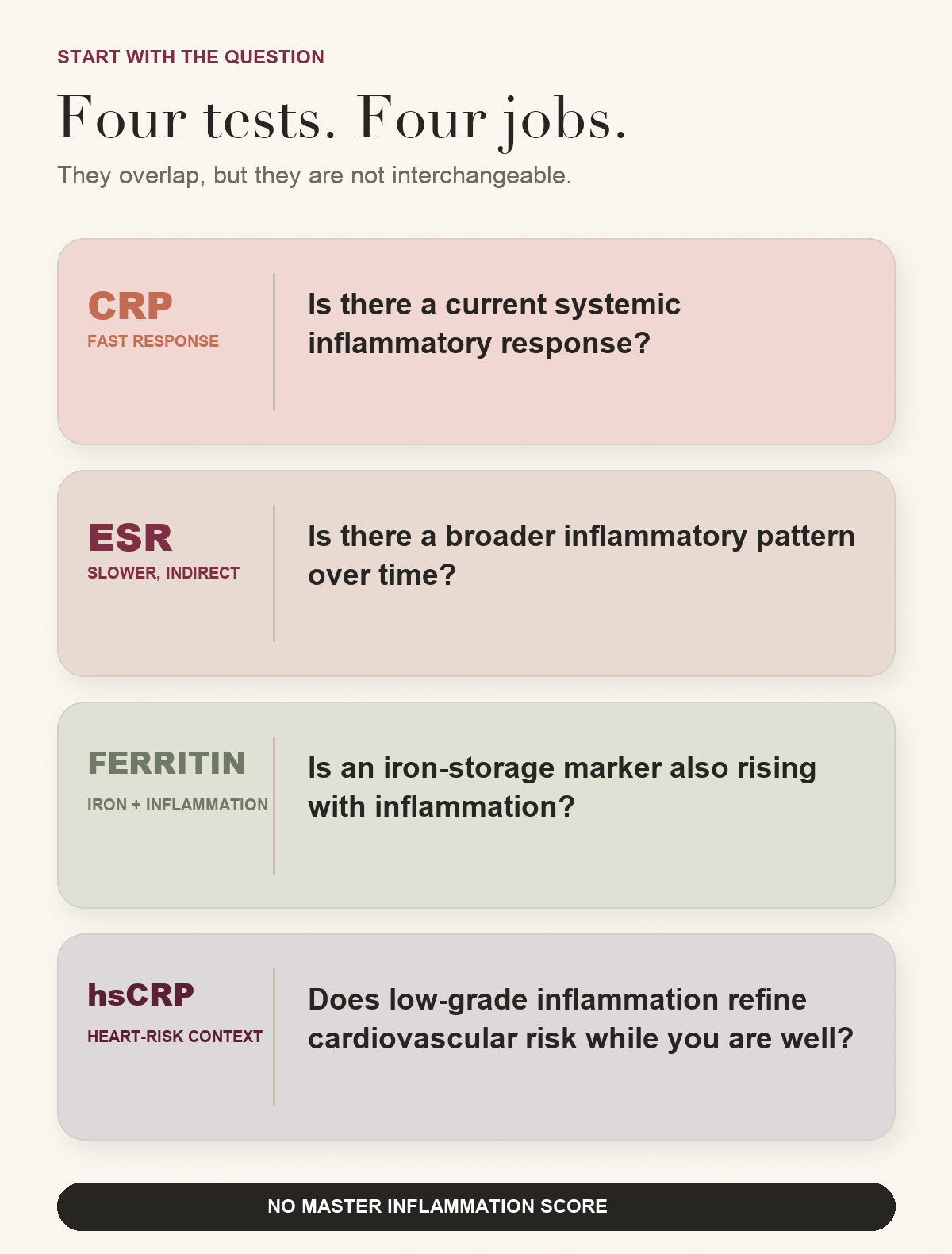
Start with what you are trying to learn. Symptoms, related labs, and timing still decide what the result means.
I put the full decision tree, interpretation ranges, repeat-testing rules, and false-positive context in Which Inflammation Test Do You Need?.
What the common tests actually measure
CRP is a protein made mainly by the liver after inflammatory cytokines signal that something is happening. It rises and falls relatively quickly. A high CRP can fit infection, autoimmune activity, injury, surgery, or another substantial inflammatory stress. It does not tell you which one.
ESR does not measure an inflammatory molecule. It measures how quickly red blood cells settle in a tube. Inflammation can change the proteins that make those cells stack and fall faster, but age, anemia, pregnancy, kidney disease, and changes in blood proteins can move ESR too. It often changes more slowly than CRP.
Ferritin stores iron, but it also rises during an acute-phase response. A high ferritin can reflect iron overload, inflammation, liver injury, metabolic disease, or more than one of these. That is why I read it with transferrin saturation, blood counts, liver tests, and the clinical context. The WHO ferritin guideline makes the same basic point: inflammation changes how ferritin should be interpreted.
hsCRP measures the same CRP protein with more precision at the low end. Its useful job is not diagnosing why someone feels sick. It is refining cardiovascular risk when someone is clinically stable.
What a blood test cannot show you
A blood marker is more likely to rise when inflammation is widespread or strong enough to change liver proteins and circulating cells. It can miss a process confined to one tissue.
That is why a normal CRP does not rule out inflammatory bowel disease, inflammatory arthritis, a localized infection, or active plaque in an artery. Depending on the question, stool calprotectin, joint fluid, imaging, a tissue sample, or a disease-specific antibody may be much more informative than adding another general blood marker.
The reverse is also true. A high CRP does not reveal the source. The number may be real while the story attached to it is wrong.
Heart risk is one special case
Atherosclerosis involves inflammation, but it does not begin with CRP. ApoB-containing particles enter and become retained in the artery wall. Lipids become modified, immune cells arrive, plaque develops, and clotting determines whether some plaques become heart attacks or strokes. (Side note: ApoB and Lp(a) describe important particle-related risk. They are not inflammation tests.)
hsCRP can add context because it is inexpensive, standardized, and tied to cardiovascular outcome data. The 2026 ACC/AHA dyslipidemia guideline treats a persistent hsCRP of at least 2 mg/L, measured on two stable occasions without an acute cause, as a risk-enhancing factor in appropriate prevention decisions.
For relative-risk shorthand, below 1 mg/L is lower risk, 1 to 3 is intermediate risk, and above 3 is higher risk. Above 10 mg/L, first look for an acute-phase response (active illness like a cold) rather than labeling it “high heart inflammation.” The ACC statement recommends repeating hsCRP in two to three weeks after the acute context resolves.
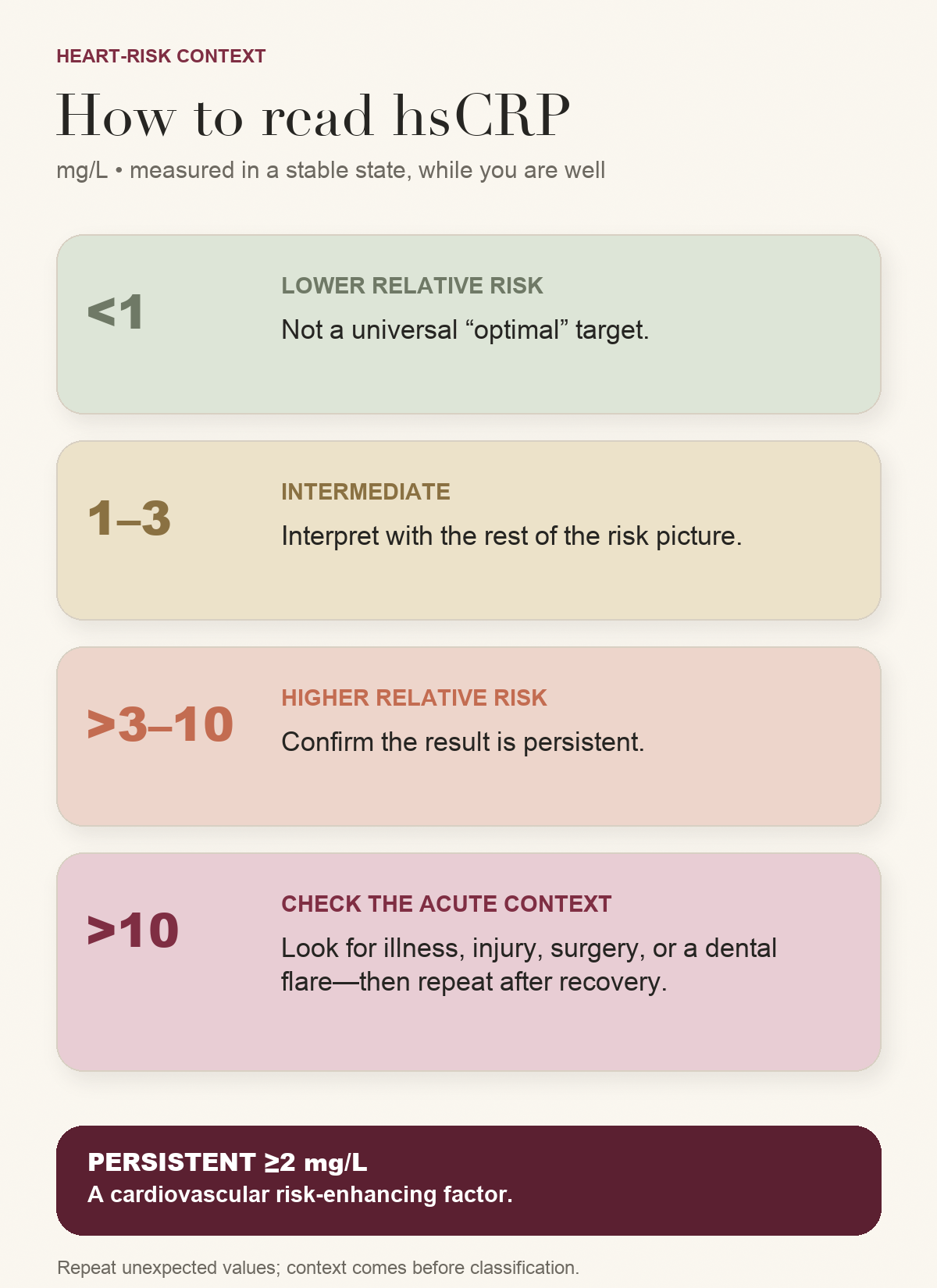
Low hsCRP does not erase the presence or risk of high ApoB, Lp(a), or existing plaque. High hsCRP does not locate an inflamed plaque.
This is also where advanced panels can get ahead of clinical usefulness. Lp-PLA2 activity predicts cardiovascular events and sits in plausible plaque biology. Darapladib lowered the enzyme by about 65%, but did not improve the main endpoint in either the STABILITY trial or SOLID-TIMI 52. People born with Lp-PLA2-lowering variants did not have less coronary disease in a large genetic analysis.
The marker was real. Lowering it was not enough to change outcomes.
I put the detailed interpretations of Lp-PLA2, MPO, oxidized LDL, F2-isoprostanes, ADMA, SDMA, and fibrinogen in the full site guide in case you want to go deeper.
What I would do with an unexpected high result
1. Check the day it was drawn. Were you sick, injured, recovering from surgery, training unusually hard, or dealing with a dental flare? A perfectly accurate result may reflect a temporary situation.
2. Check whether the test matched the question. Ferritin is not interpretable as an iron-overload test by itself. hsCRP is not a plaque scan. ESR is not a general wellness score.
3. Look for the source before trying to lower the number. Symptoms, exam findings, blood counts, kidney and liver tests, urinalysis, iron studies, and targeted tests often matter more than another broad panel. Do not build a supplement stack around one isolated result.
4. Repeat only when repetition can clarify the story. A stable-state repeat can separate a transient response from a persistent pattern. Repeating every week without a plan usually creates noise.
Imagine two people with hsCRP of 4.5 mg/L. One tested after a hard race with a sore throat. The other has repeat elevations while well, high ApoB, and coronary calcium. Same red number. Completely different next step.
Bottom line
For most of my preventive-care patients who feel well, I start with hsCRP. It covers the cardiovascular-risk question and still flags a larger CRP response that needs context. If it is above 10 mg/L, I stop treating it as a heart-risk number, look for an acute trigger, and repeat it after recovery.
If standard CRP is high, think current systemic inflammation: infection, injury, surgery, or autoimmune activity. If ESR is high, think a slower, nonspecific pattern that can travel with rheumatologic disease or chronic infection, although anemia and kidney disease can also push it up. If ferritin is high, think iron overload, inflammation, liver injury, or metabolic disease—and read it with transferrin saturation.
None of those results names the diagnosis. But they do tell you which lane to investigate. For a well adult choosing one starting marker, hsCRP is usually my first choice.
Hillary Lin, MD
P.S. The complete reference is here: Which Inflammation Test Do You Need? It includes the test chooser, ranges, timing, false-positive context, advanced cardiovascular markers, and what should prompt urgent evaluation.
Watch next: The fitness decline “good” labs miss
Standard labs can look reassuring while your cardiorespiratory reserve is already slipping.

My newest long-form conversation with Brooks Leitner of VO₂ Health explains what VO₂ max measures, why decline can hide in plain sight, and how to train for capability—not just a score. Watch the episode →
⚡ Longevity quick hits
💉 GLP-1 is getting an amylin add-on. In phase 2, weekly zenagamtide lowered HbA1c by up to 1.7 percentage points and oral dosing by up to 1.4 points over 36 weeks. Gastrointestinal effects were common; the drug is investigational.
⏳ We are adding years faster than healthy years. A Global Burden of Disease analysis found that the average time spent in poor health rose from 8.8 years in 1990 to 10.7 years in 2023, with the gap widening in 203 of 204 countries and territories.
🏥 A hospital AI alert is only useful if a team responds. In a before-and-after study of 23,132 high-risk patients, real-time alerts and rapid-response notifications were followed by more rapid-response activations and were associated with lower risk-adjusted inpatient mortality. The study was observational, not randomized.
🦷 Oral health belongs in the diabetes-risk conversation. A meta-analysis of 28 longitudinal studies found that periodontitis was associated with an 18% to 25% higher incidence of type 2 diabetes. That does not show that treating periodontitis prevents diabetes.
🦴 Delaying hip-fracture surgery beyond 36 hours was tied to higher mortality. In 5,414 adults age 60 or older, logistical surgical delays were associated with a 20% higher hazard of death over one year after adjustment.
🧪 PFAS looked linked to inflammation. The signal weakened on closer analysis. In 1,387 midlife women, PFAS levels initially tracked with hsCRP and PAI-1, but the individual associations did not survive multiple-testing correction and the biomarkers did not explain incident hypertension.
Where to find me
Science of Skin Summit, September 17–20, Austin, TX. Speaking on AI in dermatology and skin and hair as windows into biological age.
MVMNT Longevity Summit, September 22–23, Coronado, CA. Leading a session on turning longevity data into clinical action.
Livelong Women's Health Summit, September 25–26, Hilton Midtown, New York City. Joining the expert faculty on AI-driven personalized medicine.
Science of Skin Longevity Summit, February 19–21, 2027, Scottsdale, AZ. Speaking on AI in precision diagnostics and joining the peptides panel.
Support us with your longevity purchases
A few reader-supported partners:
🐟 Seatopia: sustainable seafood checked for microplastics and mercury. Code HILLARYLINMD for $20 off your first order.
⏱️ Timeline: Urolithin A, studied for mitophagy and muscle mitochondrial biology. The 20% discount applies through the link; there is no code.
🍺 ZBiotics: a probiotic designed to break down acetaldehyde when you drink. Code CARECORE for 10% off.
🧲 CoreViva: whole-body MRI screening for people weighing early-detection tradeoffs. Code CARECORE for $200 off.
🧬 GlycanAge: glycan-based immune age testing with personalized recommendations.
Advanced diagnostics
If you want physician-guided biological age testing, start on the testing page. It includes epigenetic age testing with consultation, plus organ-specific proteomic and SystemAge assessments when they fit the clinical question.
Have a question or topic you want covered? Reply to this email.
Was this forwarded to you? Subscribe here to get The Longevity Letter in your inbox.